
Free shipping from 12 bottles · Delivery throughout Switzerland

Free shipping from 12 bottles · Delivery throughout Switzerland
26 wineries from Spain, France, Italy and Switzerland. Behind every bottle are people with their own idea of wine. Meet them here.

The best soils in Utiel-Requena lie around Casas de Eufemia. Héctor Benavente and his team let herbs and shrubs grow between the Bobal vines, because the vineyard is meant to be an ecosystem, not a monoculture.
Read the portrait
The Frézier family has worked the same vineyards south of Épernay since 1823. Sébastien and Aurore are the seventh generation and do everything themselves, from pruning to the bottle.
Read the portrait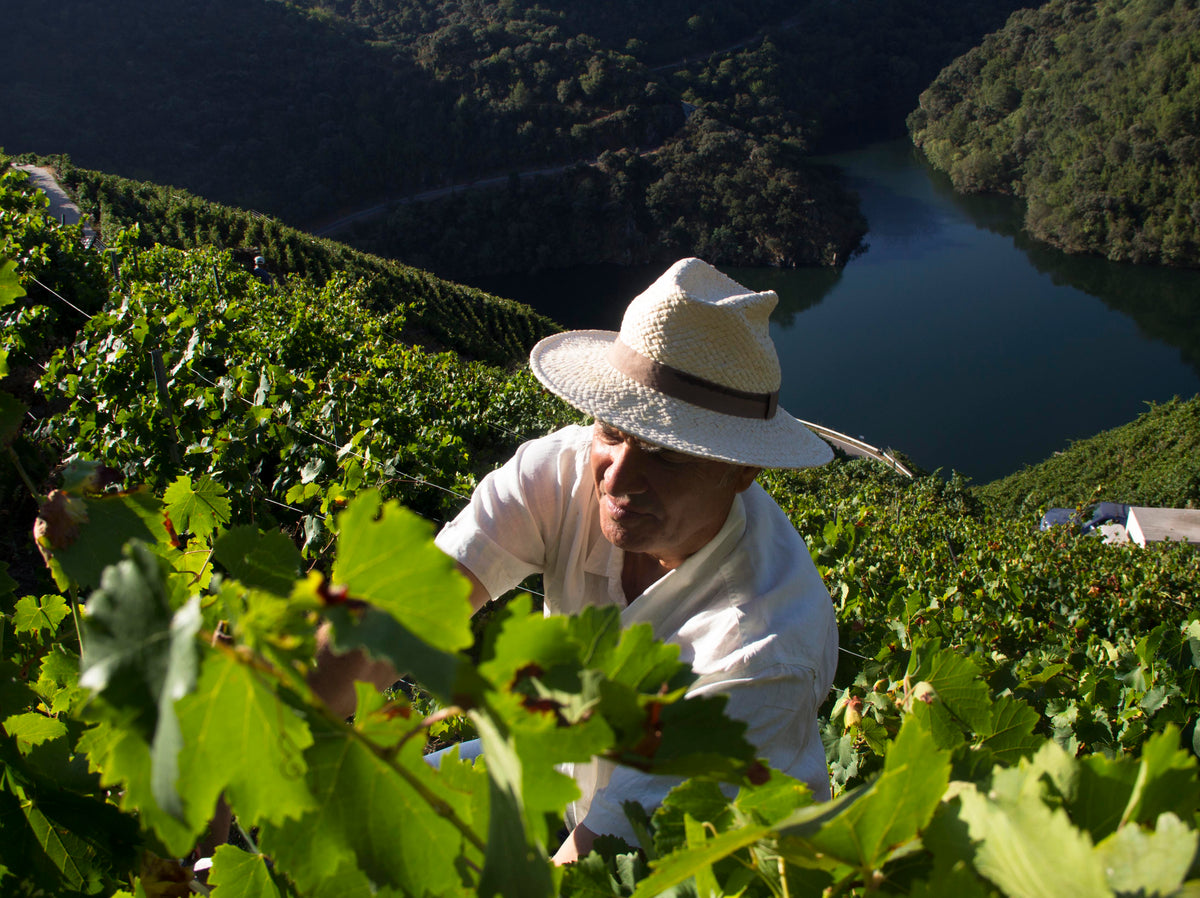
In 1979 Fernando planted his first plot on an overgrown piece of land belonging to his wife Ana's family. Today the vines grow on Roman-era terraces above the Sil, on slopes of up to 85%.
Read the portrait
Audrey, Léonie and Justine Arlon have been making wine in a pink-painted house in Les Lauves since 2013. Their parents used to sell the harvest to the cooperative, until Audrey suggested a domaine of their own.
Read the portrait
Guímaro is Galician for rebel, and it was what people called Pedro Rodríguez's grandfather. Pedro farms eight hectares on the steep slopes of the Ribeira Sacra and has brought the growers who supply him with grapes round to more sustainable...
Read the portrait
For generations, the family sold its grapes to the cooperative. Verónica is the first to make wine under her own name from the family's vines near Requena, unfiltered and with no added sulphites.
Read the portrait
Only around 50 of this finca's 455 hectares in the Garraf Massif are planted with vines. The rest is forest, scrub and rock. Jordi Esteve carries on what Carlos Esteva started in the 1970s.
Read the portrait
Oscar Hauser and Thomas Carl farm one hectare in Savièse above Sion and leave hip-high grass standing between the vines. Their Fendant has 11.1% alcohol and is sulphured only once, at bottling.
Read the portrait
María José Yravedra is one of Spain's first women winemakers. With her husband Felipe she brought the old bodega on the Sil back to life in 2010, and since then the wine there has moved by gravity alone.
Read the portrait
Brothers Robustiano and Baldomero Fariña work in the Val do Salnés, the coolest part of Rías Baixas and the closest to the coast. You taste the Atlantic in their Albariño as a distinct saltiness.
Read the portrait
José Mas makes exactly one wine, Massuria, from Mencía vines planted between 1912 and 1970. He worked for the Moueix family of Pétrus and is giving himself another 20 years to make it perfect.
Read the portrait
Two women shape this bodega in the Ribera del Duero: owner Cayetana Santos, who also owns the Páramo de Guzmán cheeses, and oenologist Mapi Melado. The bodega comes with a tunnel almost a kilometre long.
Read the portrait
Vicente García is known as “the father of Cava in Requena”. He founded the estate with his wife Ana Suria in 2002, and today their daughter Rebeca works there too.
Read the portrait
On a hill above Gargas, looking out at Mont Ventoux, oenologist Frank John from Germany's Pfalz has been converting the estate to biodynamics since 2024. The work is done without herbicides and without tilling.
Read the portrait
Carlos Carballo names his wines after his parents: Viña Aurita after his late mother, Xcelso Patao after his father, who despite his great age helps him in the vineyard every day.
Read the portrait
The Colla vineyard of Fabrizio Battaglino's grandfather played a key role in the creation of the Roero DOCG. Fabrizio vinifies each plot around Vezza d'Alba separately, so you can taste the differences between the soils.
Read the portrait
In 2019 the Fariña brothers of Attis started a project in the Bierzo with Robustiano's daughter Lía, whose mother comes from the area. Two wines bear the names of the Pico Tuerto and La Yegua mountains.
Read the portrait
This estate in the Avia valley traces its origins back to the 10th century. Today winemaker Inma Pazos runs it, ferments with wild yeasts and also works with clay amphorae.
Read the portrait
Toni Alonso makes two white wines, just a few hundred bottles a year. His Quinquenio grows at 280 metres among shards of granite and spends five winters in the cellar before it goes on sale.
Read the portrait
José Luis Torres Carpio farms around 2.5 hectares in Casas de Eufemia by the lunar calendar. Each of his wines carries the name of its plot, with vines from 60 to over 100 years old.
Read the portrait
Since 2018 Robert and Conny have run one of Mallorca's smallest wineries, among dry-stone walls near Felanitx. Only island varieties grow here, such as Callet, Manto Negro and Prensal Blanc.
Read the portrait
Félix Martínez is the third generation to run the bodega, founded in 1945. His bush vines stand at 800 metres at the foot of the Sierra del Remedio, where the Solano wind takes the edge off the summer heat.
Read the portrait
Bernard Hébrard ran the laboratory in Grézillac. When he retired in 2003, he and his wife Marie-Odile bought a neglected estate in Saint-Loubès, where the two of them now harvest by hand.
Read the portrait
Fortuné Piche never left La Suffrène. His grandson Cédric Gravier first had to spend a year in the USA to realise that home had everything, and took over the estate in 1996, aged 23.
Read the portrait
Former boxer Alain Pascal built the domaine by hand with his brother and named it after his father, “Big Noré”. Today the same rough hands tend 16 hectares of vines in La Cadière-d'Azur.
Read the portrait
From 2018, hotelier Carlos Gross made his own vermouth in Sent in the Lower Engadine, with herbs from the mountains around the village. Since his death, his sons Gian and Nico have carried on the secret recipe.
Read the portrait
I am 18 or older
Your cart is currently empty.