


Mencía: Spain's most elegant unknown
For most of the last century, Mencía was grown for the things it does worst. Colour, alcohol, volume. The grape goes along with it, and the wine then tastes of nothing in particular. What it can actually do only shows up at low yields on poor soil: violets, sour cherry, wet stone underneath.
If you associate Spain with weight, Mencía will surprise you. A good one rarely passes 13.5 percent, the tannins are fine, and the acidity keeps the sip short rather than broad. In the glass it stands closer to a Cabernet Franc from the Loire than to a Rioja Reserva. That is exactly why so many of them sit in our range, and exactly why so few people outside Spain know the name.
Nearly gone, then quietly rebuilt
Fifty years ago, the vineyards of north-west Spain were being abandoned. The work was brutal, the grapes went into bulk wine, and the young people went to the cities. What saved Mencía was not a marketing plan. It was a handful of growers who kept the old terraces, stopped chasing quantity and started bottling single plots.
Today those plots produce some of the most precise reds in Spain. The bottles are still made in hundreds and thousands, not millions, which is why you find them in a shop like ours and not in a supermarket.
Two origins, two handwritings
Almost everything that convinces us about this grape comes from two places.
The Ribeira Sacra lies in Galicia, on the steep slopes above the river Sil. The terraces date back to Roman times, the slopes reach gradients of 85 percent, and no machine gets up there. Every bunch is carried down by hand. Slate and granite give the wines a cool, saline edge that you recognise after two sips. We described what that work looks like in our piece on heroic viticulture.
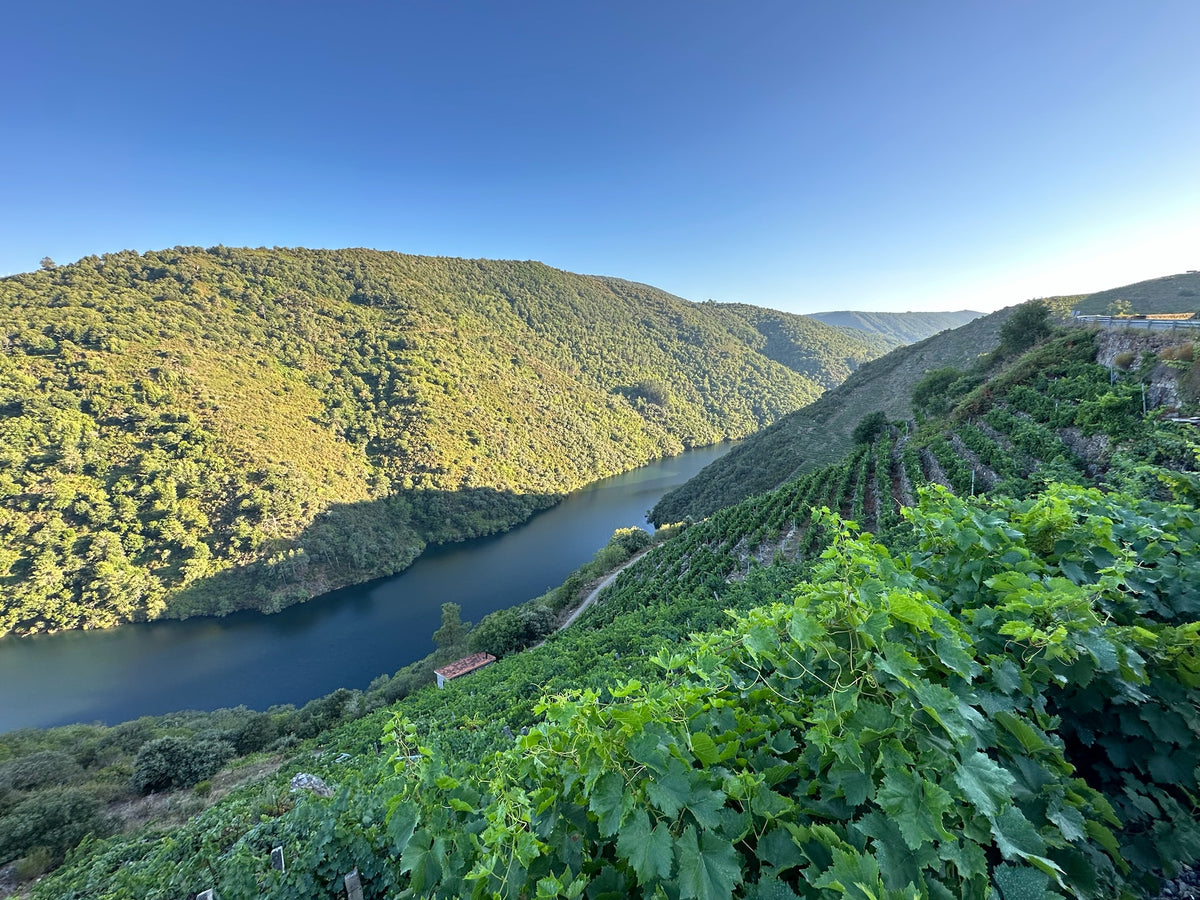
The Sil in the Ribeira Sacra. On these slopes every bunch is picked by hand.
The Bierzo sits two hours east, already in León. More clay, a little more warmth, older vines. The wines carry more fruit and rounder edges.
Our advice if you want to know both: start in Bierzo, the entry is friendlier. Drink the Ribeira Sacra after that, because the other way round the Bierzo tastes broad.
The terraces above the Sil
Three estates show how differently the same grape speaks along the same river.
Pedro Manuel Rodríguez took over Adegas Guímaro in 2001, in Sober, in the heart of the Amandi sub-zone. The name comes from his grandfather's nickname and means rebel in Galician. Working with Raúl Pérez turned a producer of young reds into a producer of single-site wines. In 2024 James Suckling named his Finca Meixemán the best wine in Spain. Pedro farms eight hectares and buys fruit from neighbours he has spent years persuading to work more gently.
Fernando González at Adega Algueira planted his first parcel in 1979, on a piece of overgrown land belonging to his wife Ana's family. Today it is 25 hectares split across 86 plots, and Algueira is one of very few Spanish estates admitted to the Place de Bordeaux. His Pizarra is the bottle we open when somebody tells us Spanish red is too loud for them.
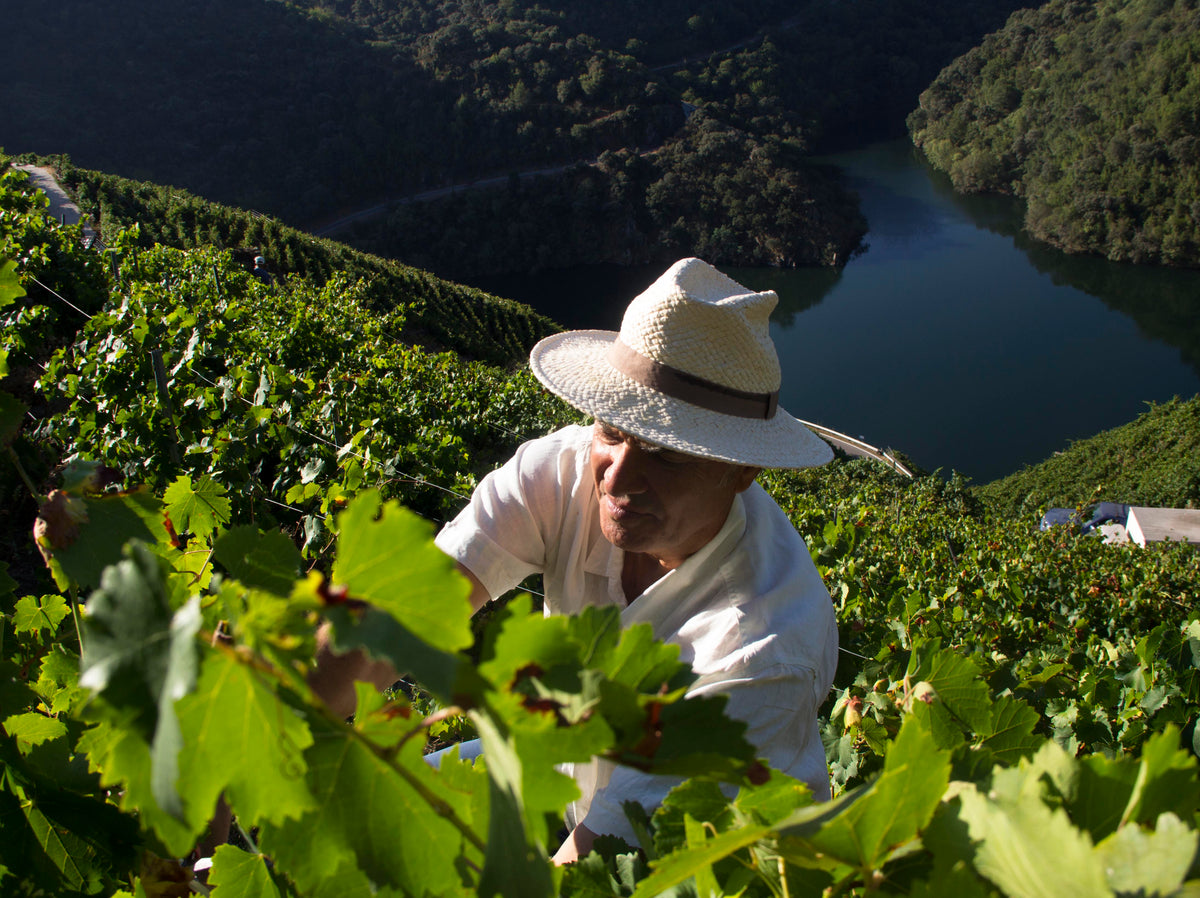
Fernando González at the 2019 harvest.
María José Yravedra and Felipe Somarriba rebuilt an old winery in 2010. She is an oenologist, he is an architect, and they designed the cellar so that the wine moves by gravity alone, with no pump. Ten hectares, all picked by hand.
One grower, one wine
José Mas makes exactly one wine in Bierzo, the Massuria. Four hectares, twelve plots, vines planted between 1912 and 1970, around 15'000 bottles a year. Before he went back to Villafranca del Bierzo he worked with the Moueix family in Pomerol and Saint-Émilion, where wine is built for decades rather than seasons.
You taste that decision. Young Massuria is almost stern. After eight years it turns soft and spicy, and the fruit that seemed hidden comes forward. We kept older vintages back for this reason, going down to the 2010. If you want to know how far Mencía travels, drink one of those, not a young one.
One grower, one wine
Young Massuria is almost stern. After eight years it turns soft and spicy.
See Massuria 2010Carlos Carballo follows no rulebook
Carlos works in A Pobra do Brollón, inside the Ribeira Sacra, and bottles deliberately outside the DO rules. His father, known to everyone as Patao, still works the vineyard with him every day despite his age. The wines carry the names of his late mother Aurita and of his father.
In 2023 he lost more than 70 percent of his crop. Fourteen bottles of the white Aurita made it into glass. Opening his Viña Aurita Tinto means drinking a wine that will not exist in the same shape next year.
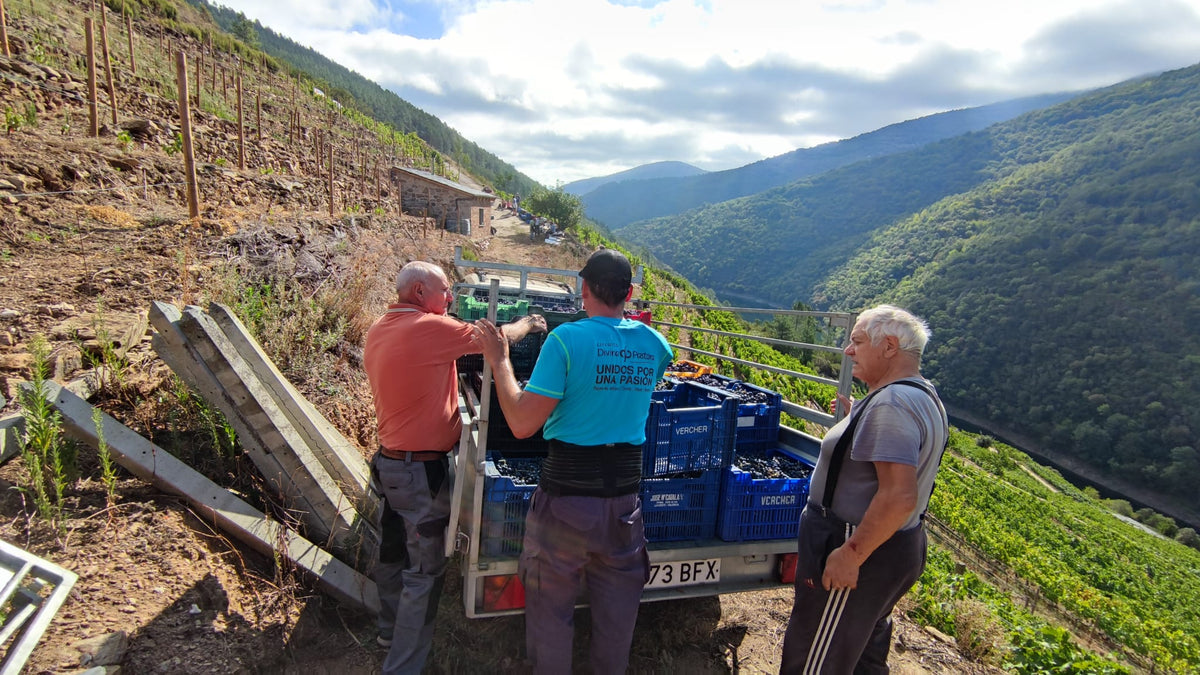
Harvest at Carlos Carballo's.
Where to start
All Mencía-
Mencía 2023, Guímaro
The honest way in. Fruit, herbs, no oak in the way.
CHF 18.00
-
Vel'Uveyra Mencía Barrica 2023, Ronsel do Sil
Same region, with barrel, a little more depth.
CHF 19.00
-
Patrimonio 2018, Algueira
The slate, clearly audible.
CHF 25.00
-
San Pedro 2021, Guímaro
A single site, very precise.
CHF 25.00
-
Finca Meixeman 2022, Guímaro
Suckling's number one. Give it an hour.
CHF 29.00
-
Massuria 2010, Mas Asturias
For the evening when you have time.
CHF 49.00


How to serve it
Serve Mencía at 15 to 16 degrees, cooler than most reds. Too warm and the fruit turns jammy while the fine acidity disappears. Half an hour in a decanter helps the young bottles. The older Massuria needs no decanting, just a large glass and some patience.
It goes with lamb, mushrooms, grilled vegetables, hard cheese, and in Galicia of course with pulpo. It also handles the awkward dishes that defeat heavier reds: tomato sauces, smoked fish, anything with vinegar in it.
If you take one bottle, take the Guímaro. If you take two, put the Massuria next to it and leave it alone for a year. The difference between those two explains this grape better than another paragraph from us.
